
Parks and Play Strategy 2025
Council’s Park and Playground Strategy 2017 is scheduled for review, leading to the preparation of the draft Parks and Play Strategy 2025.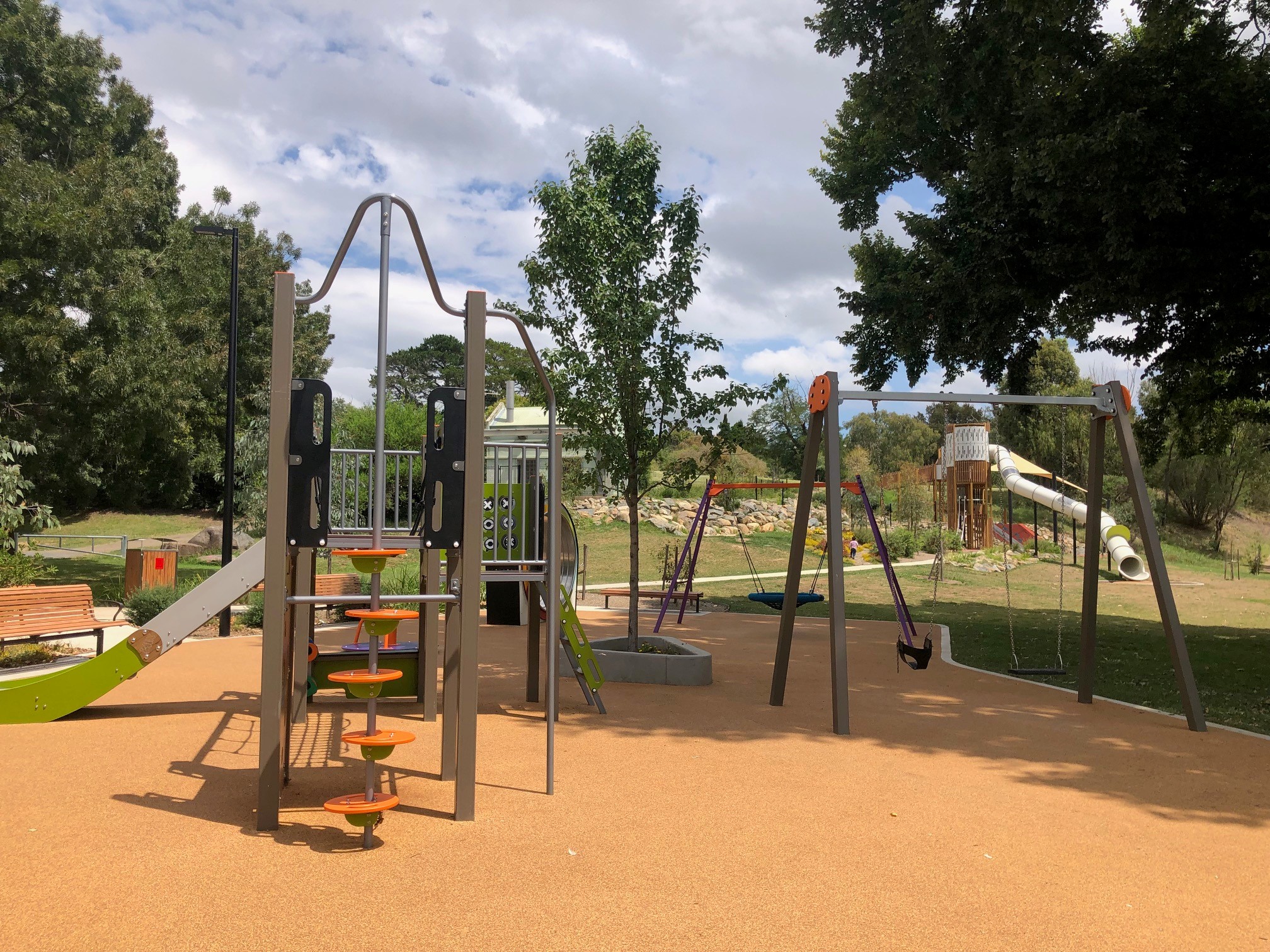 Riverbank Park, Yass
The draft Strategy outlines Council’s vision for the planning, development and ongoing management of parks, playgrounds and play spaces across the Yass Valley.
It incorporates elements from:
(i) Yass Valley Open Space Strategy 2024-2036
(ii) NSW Everyone Can Play Guidelines (updated 2023)
(iii) Council’s adopted 2025 Integrated Planning and Reporting documents
More specifically, the draft Strategy includes:
• Renaming of park categories
• Introduction of guiding principles for parks and play
• Review of community and stakeholder engagement
• Introduction of play space development model
A copy of the draft Strategy is in the Documents section (right).
What Next?
This draft Strategy was endorsed at the 27 November 2025 Council Meeting to be placed on Public Consultation for a period of no less than 28 days and now provides an opportunity for members of the community to provide their feedback. This document will be available for review over the Holiday period.
- Have a read - Please have a read of the attached draft Parks and Play Strategy. Please take the time to understand what it is in document and what it means for you and the local community.
- Ask a question - If you have any queries or need clarification, please use our 'questions tool' below.
- Complete the below feedback form - if you have any comments, please leave your feedback below. Your feedback is important as it will inform Council's final decision on this strategy.
- Other ways to provide feedback: You can also make a submission by email to Council@yass.nsw.gov.au or by writing to Public Consultations, Yass Valley Council, 209 Comur Street, Yass, NSW, 2582.
Any person may make a written submission to Council on the draft document until 5.00pm Saturday 31 January 2026.
In accordance with the Privacy and Personal Information Protection Act 1998, Council will redact any names, email addresses, contact numbers and residential addresses from all submissions received prior to inclusion in the future report to Council.
Thank you for taking the time to share your views.
Please give us your feedback
Thank you for the opportunity to contribute feedback about the draft Parks & Play Strategy through Council's new Your Voice Counts initiative.
I wish to note at the outset that developing a Strategy that fits within broader frameworks and meets the needs of many stakeholders is not an easy task, especially when seeking to balance so many competing considerations.
My feedback below is provided as constructive suggestions and observations offered in the spirit of continuous improvement, with the intention of supporting the development of a final strategy that proves both appropriate and useful for Yass Valley. Rather than attempt to provide feedback on all areas of the draft, my feedback summarises my key initial thoughts/reactions – to which I’ve added brief explanatory notes.
******
Strategy alignment
While some (not all) other strategies and plans that relate to this Draft strategy are briefly noted within this Draft, various aspects of these documents appear to have been either ignored or replaced/superceeded by this Strategy without any explanatory notes for doing so.
o A simple way to ensure this strategy is aligned to other relevant details is to provide cross references in this strategy.
It is particularly concerning that this draft’s child-centric view of play is at significant odds with the NSW Government’s Everyone Can Play framework – a higher level document that:
o is built on the principle that play and recreation are vital for all ages, abilities, and cultural backgrounds: and
o specifically encourages the design of intergenerational spaces, where seniors and other adults can be active alongside children.
Why would Yass Valley Council choose to adopt a Parks and Play strategy that's so clearly misaligned with the principals of NSW’s Everyone Can Play framework?
o I am aware NSW's Everyone Can Play framework is not a mandatory playspace planning/building code.
o I am not aware of why our Council would choose to ignore/override statewide guidelines that could so easily be incorporated into it’s Parks and Play strategy
While some people choose to limit their view of the word "play" to children, it's difficult to understand why Council would want to reflect such an outdated view in its Parks and Play Strategy.
o Yet by choosing to limit the strategy's definition of "Playspace" to "an area specifically developed for childrens play" (ref page 5) this is what this Draft does.
For example, under the page 9 heading “Understanding play”, the Draft clearly states that those who play comprise of four groups of children (ie Infants, Toddlers, Juniors, and Youth) — and is silent on the needs of the rest of our community (including seniors like me!) who also want to be able to “play” in Yass Valley’s public playspaces.
o NSW’s Everyone Can Play framework recognises benefits of inclusive play, and uses the word play to include outdoor exercise equipment that adults typically enjoy “playing” on.
From a grants/funding perspective, I believe it would be financially prudent for Council to ensure its Parks & Play strategy very clearly and directly aligns with to all relevant state (and federal) government frameworks, guidelines and other applicable overarching documents.
o Simply mentioning the existence of a very relevant overarching document upfront is highly unlikely to be viewed favourably by those involved in any potential state/federal grant approval processes
o If our Council chooses not to align its Parks & Play strategy with the NSW Everyone Can Play framework (&/or any other higher-level documents of relevance to this Strategy) —summary details of Council’s decision should at least be noted in, or appended to, Council’s Parks & Play strategy.
From the perspective of a senior who would love to be able to meet, play with and be inspired by Yass residents of all ages & abilities, I was expecting this strategy would at least acknowledge some of the play needs people like me have. Follows is a brief feedback regarding this point that aligns directly with the NSW Everyone Can Play framework
o Inclusive play equipment
o Multigenerational Design
o Social Connection
o Accessible Surfacing
Inclusive Play Equipment
It is my understanding that our state's guidelines recommend choosing equipment that accommodates a variety of physical sizes and abilities. Examples of inclusive play equipment that I've seen/used when travelling in NSW typically seem to offer three types of equipment for seniors like me:
o Cardio & Mobility: Aerobic walkers, exercise bikes, and rowing machines designed for low-impact movement.
o Balance & Dexterity: Balance beams, stepping poles, and hand wheels to help prevent falls and maintain joint health.
o Strength & Resistance: Chest presses, shoulder presses, step-ups and leg presses that use the user's own body weight for safe resistance training.
Adult play equipment I’ve used is typically in locations that also feature the "Stay" elements recommended by the Everyone Can Play guidelines (eg shaded seating with back rests, water stations, clear instructional signage with large text and illustrations)
Rather than simply sticking a lone pullup bar in a corner of a park (eg Connor Park) and/or in locations that are too challenging for many people with mobility aids/limitations to access (including in distance from car parking and bus stops), it's my understanding that the NSW Government framework encourages, for example:
o Multigenerational Design
Placing outdoor adult play equipment within sight of a children’s playground enables a grandparent to stay active while supervising a grandchild. It is also is a terrific way of encouraging lifelong play (ie the more children see adults playing alongside of them — the more normalised lifelong play becomes)
o Social Connection
Designing playspace layout so that equipment faces inward, encouraging conversation and reducing the social isolation
o Accessible Surfacing:
Ensuring that the area leading to, and around play equipment is firm and level (such as rubber soft-fall or paved paths) so that those with mobility limitations/aids (of any ages) can safely access play equipment
I was expecting this Draft to at least include/attach summary level details regarding the current condition of Council's existing park & play assets
o It would be helpful if such detail was provided by equipment type — more so if also by location, alignment to this/other Council document and other higher level Govt guidelines/other documents of relevance to this strategy
I was surprised that this Draft contains very little detail about Council’s park and play assets that many stakeholder groups would reasonably expect to be included/attached to this type of document
o Clearly stating upfront the Draft’s intended audience, and other key stakeholder groups (within envisaged duration) might assist those involved in improving this draft to do so in ways that include the type of information that will prove helpful to those who will read/use this Strategy
Water Play — Places to Swim
As a regular user of public pools, I was looking forward to reading the aquatic aspects of Yass’s parks and play needs.
Aware that Council has explored various options related to public built and natural swimming places over the last 30 years or so, I was hoping that finally Council would finally adopt a strategic approach to their management of our natural and built swimming pools, including options that better meet our ever growing population. It is extremely disappointing that this strategy doesn’t even acknowledge the fact that people who live in Yass Valley who need/want to exercise in a public pool throughout the year currently have to travel to Canberra/Goulburn to do so.
o I have met a surprising number of Yass Valley adults in the ACT public pool I go to three times a week. Some go the pool to swim/train, some to do aqua-aerobics, some to do prescribed aqua-therapy exercises, and others (like me) to do all these. Everyone I’ve met also enjoys the social interaction and other benefits that come with using a public pool reguarly.
It is my understanding that
o The NSW Government has released a supplementary guide to their Everyone Can Play guidelines titled Everyone Can Play – Water Play
Interactive water elements (eg splash pads, water fountains, misting stations etc) are considered "playspaces" because they focus on discovery, sensory experience, and social interaction — whereas
Primary "aquatic recreation" infrastructure (eg 50/25m lap pools) are generally governed by other NSW/federal government standards and guidelines.
o To address the gap between public playspaces and swimming pools, the NSW Government also have a companion program called Places to Swim, which takes the Everyone Can Play philosophy (Inclusion, Accessibility, Can I Stay) and applies it specifically to natural and built swimming sites, including public pools and river swimming spots such as those we have (and those many like want) in Yass Valley.
Reflecting on the above, and the importance our community places on ensuring our many natural and built swimming sites are well managed by our Council, it is difficult to understand why Council would choose to be silent on the aquatic aspects of its Parks and Play strategy.
I believe Council’s Parks and Play Strategy should least mention the location of our loved public “Places to Swim” that are in/adjacent to our public parks. and indicate if/how they align to this strategy, especially
o the 2 public swimming pools located in the Victoria Park Precinct that, similar to those in Binalong are used for both aquatic play and recreation, are Council managed — and most likely will require Council to seek external grants to fund capital works/upgrades within the lifespan of Council’s Parks and Play Strategy
o the most popular of our many natural swimming locations (including those around Swinging Bridge Reserve, Billy Grace Reserve, Micalong Creek & Connor Park)
I also believe Council should take this opportunity to finally ensure it has a clear strategy to meet our growing community’s current and potential future aqua play and places to swim.
o If/when doing so, please note that instead of simply considering a very small, purpose-built to meet hydrotherapy pool user needs (which I noted when browsing related council documents/consultant concept plans that are not even mentioned in this Strategy) — please consider the option of a warm water program pool that can be used not only for a wider range of gentle warm water exercise, but also for year long swim school/program use, and many other purpose), located next to aqua play facilities suitable for non-swimmers and land based public play facilities, as per the integrated public leisure centre model adopted in many other towns throughout NSW, ACT & elsewhere.
Other observations
I was surprised to see this draft strategy is silent on many other issues. For example, I was expecting this strategy to indicate:
o Its intended audience and main park/play/related needs of each of key stakeholder group
o Park/playstation safety and related matters (inc min standards, risk management, etc)
o How this strategy’s appropriateness and efficacy will be monitor
o Strategies re public-private options of relevance to public parks , including (for example):
the role of private developers vs council’s role re new public parks and playstations to be located in new estates (including quality & quantity by type, ideally based on planned new population demographics — ensuring they are designed to meet the needs of those new local communities — capital costs, maintenance costs, insurance, etc)
council role vs that of others who organise events/activities at our public parks/play stations (including public notice requirements, risk mitigation, insurance, etc) by category (inc: free public access activities, paid public access activities, large privately organsised events, small privately organised events, etc)
o If/how public places used to play tennis/football/many other sports are integrated with this strategy — especially those located within our public parks
o Council’s expectations re development/refreshment of lower level plans of relevance to this strategy (eg Village-specific recreation plans)
Thank you again for the opportunity to provide feedback, and I trust the comments above will be received in the constructive manner in which they are offered.
Judy Huxley
We support the intent of the Parks and Playgrounds Strategy but believe it would be strengthened by clearer alignment with existing Council planning documents, particularly the Open Space Strategy. The draft Strategy relies heavily on town Masterplans to guide implementation; however, Murrumbateman does not yet have a Masterplan, creating a significant gap for planning, prioritisation and delivery in one of the Valley’s fastest-growing communities.
While the document references inclusive design principles, it does not clearly articulate how these will be applied across Yass Valley, particularly in rural and village contexts where facilities are limited and distances between spaces are significant. Greater guidance is needed on how accessibility and inclusion will be practically delivered in these unique conditions.
We also note that First Nations recognition is included at the beginning of the document, but this is not meaningfully carried through. There is an opportunity to strengthen the Strategy by outlining how Ngunnawal heritage, knowledge and ongoing involvement will inform the planning and design of parks and recreation spaces, particularly where these overlap with areas of cultural significance such as the Yass River corridor.
The Strategy would benefit from clearer guidance for future development, including recognition of the importance of embedding recreation and open space provision early in new growth areas, rather than leaving this as a retrospective burden on Council. It also needs to recognise the lack of available public space, in Murrumbateman in particular, and the need to prioritise the opening up of new sites for future recreation.
Finally, “all-ages” provision must genuinely mean all ages — from babies through to seniors. In many communities, seniors and grandparents are primary carers for children, and parks and playgrounds must be designed to reflect this reality. Accessibility considerations should therefore extend beyond play equipment to include safe and continuous pathways, adequate seating, shade, accessible parking and toilets. Parks and playgrounds are vital community gathering spaces in rural areas and should support intergenerational use.
There is currently limited consideration of young people aged 12+ in this strategy, whose needs can often be met within existing parks through flexible, low-cost elements such as youth hang-out spaces, informal sports facilities, music or performance areas, and multi-use features (Goulburn provides some good examples of this). Contemporary research shows that youth engagement requires more than the traditional 1990s skate park or BMX model, which does not suit all abilities, genders or interests. Existing parks can be adapted to better support young people alongside their siblings, parents and carers, creating more inclusive and connected community spaces.
The MCA has submitted a detailed submission identifying specific areas of inconsistency and improvement to Councillors and Council staff.
Muurumbateman Community Association
Thank you for the opportunity to comment on the important Parks and Play Strategy. My comments are as follows:
Summary: General Comments
There’s little granularity or specific data to assist Council as the asset owner with decision making for management decisions now and the future. It’s a generic report complied without inclusion of aspects specific to the region, particularly about existing and proposed future population and housing density. This leads to the strategy being silent on future needs in both existing and new areas and how the Council might prepare the future needs. Does the Council need to enhance any smaller parks which are becoming overused or ‘rest’ some.
The strategy points to other documents eg Strategic Plans, Masterplans, Delivery Plans but it doesn’t show the Council’s hierarchy of plans and funding availabilty and potential sources. This is important to understand decision making.
This strategy should also be linked to the Operation and Delivery Plan. It has no reference to current or future upgrades and who they might be achieved.
The strategy does not assist with location or requirement of play facilities in existing or new development areas eg in section 7.2 ‘New playground installations relate to new development areas and are required to be provided/funded by developers. The strategy should note where this has occurred and how needs are assessed for play in new and infill sites.
The strategy has no reference to key health issues in Yass and other places in Australia ie shading and how this is/should be achieved, methods to activate parks installation of seating where there are older residents, or points of difference – having certain equipment in one park and not another.
The strategy may benefit by including public private playspaces eg playspaces in schools and clubs. Even though the Council doesn’t manage these sites, its helpful to identify their location and the type of equipment in the area.
Given the increase in number of domestic animals/dogs and people travelling with their pets, the strategy should include some commentary and policy on dogs in parks ie on lead etc.
The Strategy should also confirm if it includes Dog Parks (which I recommend it does) due to the increase in people owning domestic animals and the popularity of the dog park at Yass. Dog parks are particularly important to people travelling and I’ve noticed a few service stations on the Hume Highway are now including Dog Parks. The strategy should include them in this strategy.
The Strategy should discuss how it treats parks that are rarely used. What could it do to increase usage?
The Strategy Overview - summary
The overview is a process statement and doesn’t give the reader an overview of the Yass Valley’s Parks and Play strategy eg. The Yass Valley has xx parks managed by YVC, including xx ovals, xx tennis courts, xx pools. The Council aims to make these areas accessible to the community throughout the year and encourages their use. (How does the Council encourage use?)
The following sentence is ambiguous ‘This strategy identifies a holistic approach to identifying the needs of a playspace’. Is the policy directed at ‘playspaces’ or ‘play’. This should be clear and the title says play but on p 5, playspaces is used. The current strategy (I feel doesn’t provide an approach. Its too generic and really needs to include specific details of parks and their use to be of value.
The first sentence alludes to the document being of strategic intent about identifying the location of new recreational/play facilities ie in development areas. The table of contents is silent about the location of new recreational/play facilities. Strategies should be clear about how existing assets (playspaces) are managed but must also consider the future needs especially when the population is estimated to increase.
1.1 The strategy should list or refer to the Appendix that lists the parks and reserves and develop a summary ie the Yass Valley Council manages xx parks. Its currently generic eg ‘Council has several parks and reserves throughout the LGA which are used for leisure activities.’ Why is leisure used when the strategy is about ‘play?’
Q) Why does the strategy limit the definition of a playspace to ‘children’s play’. This contradicts the sentence in the overview: Council aims to provide parks and playgrounds (or are they playspaces) that are challenging, safe, fun and inclusive for everyone whilst promoting active and healthy lifestyles. ‘ I don’t think ‘whilst’ is the appropriate word Consider ‘that’ promote active and healthy lifestyles.?
List the number of playspaces.
Why doesn’t the strategy cover sports fields as many of them have a playspace/playground near them eg Walker Park?
4.3 is terrible. This section is a lost opportunity. It should discuss current locations of playgrounds, areas of growth, population increase etc
Given the majority of the play equipment in our playspaces is modular, the statement ‘Council playground areas are custom designed to suit the site’ is not correct.
4.5 – Masterplans for Villages
This section should refer to the parks and playspaces in villages and the role of these areas have for locals and visitors.
Recommend the Strategy summarises the play spaces of the villages that are part of the Masterplans eg Binalong
4.7 – Inclusive Playspace Experiences. The sentence notes that 0-12 year olds have the highest participation rates for park usage which might be the case but this fact (if it is one) should be referenced. If participation by young people (0-12) is associated to the type of equipment , which I assume it is, then why don’t we use the census data for Yass, to assist decision making about what equipment might be needed and used by older children and older people. What do our playspaces offer for youth?
4.10 – Village Recreation Grounds. Its unhelpful that the Strategy lists activities that ‘may include’. The strategy should name the location of Village Recreation Grounds and the existing facilities then make recommendations about future needs based on previous consultation eg Pump Track or Walking Track or population growth ie more of certain types of facilities.
4.11 – Park Locations
The diagrammatic figures aren’t helpful in understanding the needs of the parks and the facilities. The Legend is particularly poor.
For example, the icon for both the township and local park is the same. Given the strategy uses population metric 0-500 etc to determine the needs of the park heirarchy, Council might consider overlaying park type and number of houses to give an idea of how many houses/people the park services.
Why is the strategy using generic terms and has nothing specific to the area ie eg the names of the parks named even if it’s a street name – eg Townsend Street Park.
The strategy should also consider growth areas. What about the ‘play facilities in Hamilton Rise or other development areas? New development areas should be identified in the Figures.
Section 5 is adapted from a playspace strategy for a larger city and isn’t fit for purpose. I’m unclear how the hierarchy assists people’s or the Council’s understanding and management of their assets. For example, the least helpful category is Township/District Park/ Yass has both Township and Regional Parks so the definitions used aren’t helpful.
The strategy is silent on the different needs of the parks in our towns and villages eg the neighbourhood parks are generally used by locals who live in close proximity and visitors (larger parks eg Coronation and Riverbank). The park at Murrumbateman often has short stay visitors – people stopping whilst driving through. These should be considerations in developing the needs of the parks.
Playspace Design Approach doesn’t include any reference to community needs. It recommends play objects that have no reference to site or needs. For example, what about nature play, reduction of use of plastics in parks, creating meaningful places that embrace the site rather than impose structures as the only form of play.
The strategy is also silent about the needs of older residents. Parks and playspaces in the Yass Valley should have recommendations about facilities for older people – seating etc
Inspections, Maintenance and Upgrade
This program is very basic. It should reference usage data and population growth. The inspection regime should be linked to the park hierarchy and type of equipment eg flying fox, swings may require a different type of inspection than static equipment
Maintenance Service Levels - The same comments (above). This is a generic plan. For example the Council should have quite detailed records on the volume of rubbish at various parks. Some bins in Riverbank Park over summer for example, might require bi-weekly emptying or daily as they are located adjacent to picnic tables. The same comment can be made for cleaning of equipment – which I think is referring to BBQ’s ?
The strategy is silent on how the Council should manage woody weeds which are a problem particularly for Riverbank park due to the seed source of below the high school.
The Maintenance schedule should mention key times certain weeds should be addressed ie spraying for Cats Eye Bindi's (Tribulus terrestris) which is present in many of our playspaces and recreational grounds.
All the images in the Local/Village Parks show low quality space. Does Council have any data on park usage that could be included in this Strategy?
Fleur Flanery
I can only write about my suggestions for Riverbank Park.
Please include policy that enhances and maintains the variety of native plants and shrubs endemic to the Yass Valley area. The landscaping at Riverbank park is beautiful, and wildlife live there, so this is an important environmental consideration.
The play equipment at our parks are also wonderful. Please include policy that regularly maintains these.
In relation to determining improvements, I strongly feel there should be stronger policy and procedures for protecting the flora and fauna of area. The wide variety of attractive play areas, BBQ facilities and seating will always attract more pople. With more people come their litter, including helium with attached strings, plain and water balloons, plastics, food scraps. Such things attract vermin and strangle wildlife or enter the river. I understand there are bins, although they are often overflowing and many people do not take their rubbish with them.
Included in your policy should be a more regular clean up of the area, some signage which educates people on the harm that litter cause to wildlife and the river, more bins, a no balloon policy, and bins down at popular fishing spots. Balloons are fine in halls, in closed stadiums, in houses, but NOT in nature.
People picnicing in the area often also fish there. There have been devastating incidents of flying foxes and birds being strangled by fishing wire and injured by hooks down by the river. It is a slow and painful death. TAngler Bins by Oceanwatch Australia provide bins https://www.oceanwatch.org.au/tangler-bins/ and this page will provide information https://www.dpi.nsw.gov.au/dpi/fishing/recreational-fishing/responsible-fishing/reducing-fishing-litter,-lost-gear-and-pollution/bin-your-used-line-and-hooks#:~:text=Hook%20and%20line%20bins%20are%20designed%20to,The%20bins%20have%20been%20installed%20since%202021.
Thank you,
Jane O'Sullivan

Who's Listening
-

Phone 6226 1477 Email parks.assets@yass.nsw.gov.au
Thank you for your contribution!
Help us reach out to more people in the community
Share this with family and friends